My Grandfather Opened the Shop in 1966. We Just Made Claude CEO.
Three generations of family menswear retail in Turkey. My grandfather opened the shop in 1966. My father modernized it in 1985 and ran it ahead of national chains by 2000. I brought the agent in starting 2025. In 2026 we made Claude its CEO. The TUI came back. The operator is the agent. We are the hands.
Emre SavaşA few weeks ago I opened a terminal that Claude Code had built for me to look at one of our retail databases. The screen was eighty columns of monospaced white-on-black text. A column of products. A column of turnover figures. A column of dates. Arrow keys to move through rows. I sat there for a minute before I realized why I could not stop looking.
I was nine years old, standing behind my father at the back of his store. He was typing into the same eighty columns, on a fourteen-inch CRT, running a Turkish retail ERP called ETA over DOS. The year was 1997. Three decades of computing wrapped around the world between his terminal and mine, and the interface came back unchanged.
This is a story about that loop closing. It is also a story about three generations of one small business in Turkey: my grandfather, who opened the shop in 1966; my father, who modernized it in 1985 and ran it on technology the national chains did not have by 2000; and me, who in 2025 started letting an agent into the operating room, and in 2026 quietly handed it the keys.
- 1966My grandfather opens the shopA tailor's shop in Turkey. A man, a tape measure, a notebook.
- 1985My father modernizesTakes over and rebuilds it into a proper retail business.
- 1997DOS ETA on a fourteen-inch CRTA retail ERP nobody else in the category is using yet.
- 2000Multi-store, IBM stack, VPN across branchesEvery register writes to one central database. Visibility the national chains do not have.
- 2025I let the agent into the operating roomRead-only at first. Then more.
- 2026Claude is the CEOThe TUI came back. The wrapper went away.
1966 · My grandfather opens the shop
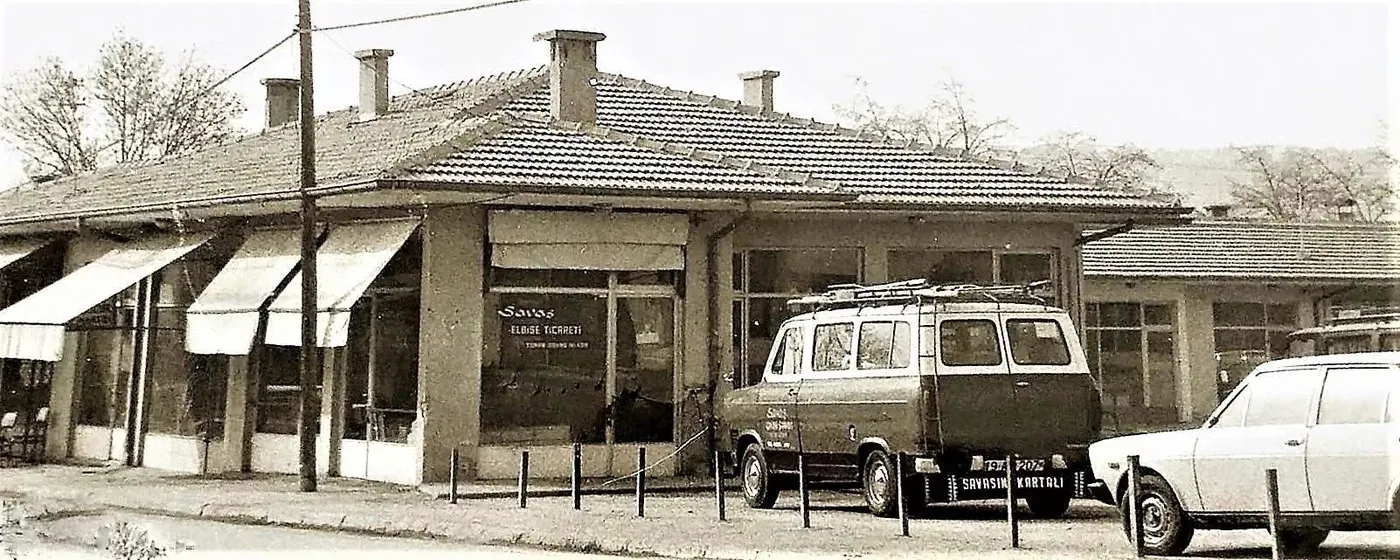
The first shop · my grandfather’s era
In 1966 my grandfather opened a menswear shop. Turkey in the late sixties was not a country with many things. The shop sold trousers, jackets, shirts, the suit a young man needed for his first job and the suit a slightly older man needed for his wedding. The customer walked in, walked through to the back, was measured, and walked out with a parcel under his arm. That is the business. It has been the business for nearly sixty years.
It was a small shop run by a man with a tape measure and a notebook. There was no electronic anything. There was no question that there would ever be electronic anything. The point of the shop was the shop.
1985 · My father modernizes
In 1985 my father took the shop over and turned it into a proper modern retail operation. He kept the trade his father had built but rebuilt how it was run. New fixtures, new presentation, a real shopfront. Bigger inventory. A category buyer’s mindset. The customer who had walked into a tailor’s shop in 1965 now walked into something that looked like a real store.
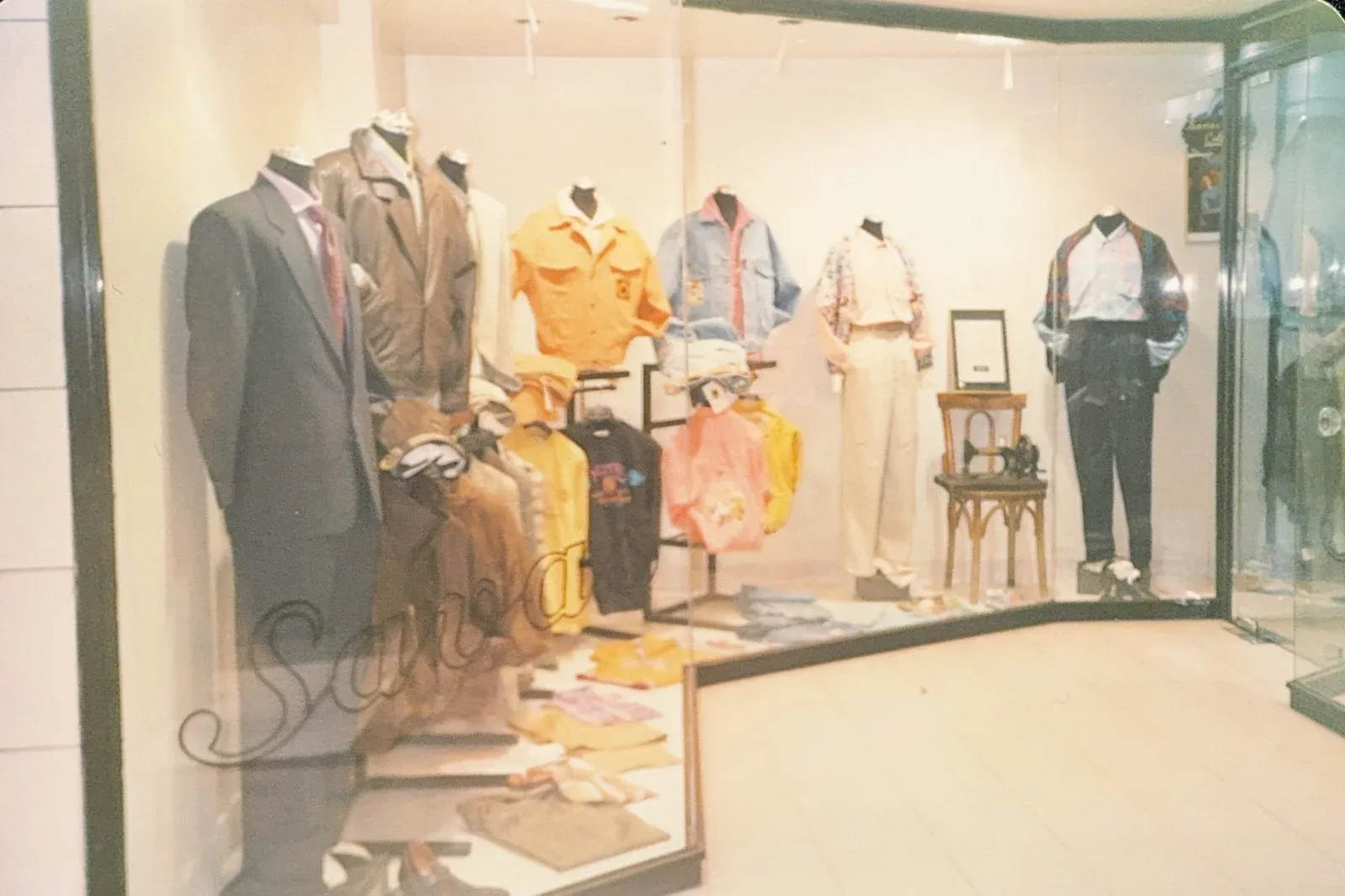
1985 · the year my father took over and turned a tailor’s shop into a retail business
This is the moment that matters for the rest of the story. My father did not inherit a small business and keep it small. He inherited a small business and rebuilt it into something with a shape that could scale, because the next twenty years of his life would be about scaling it. He was, in 1985, doing exactly the kind of operational rebuild I would, in 2025, end up doing again on top of his version. The same impulse skipped a generation and came back wearing different clothes.
Late 1990s · My father bets on technology nobody else had
My father did two things in the nineties that I now understand as the same thing.
The first was that he started selling trousers by newspaper ad. This was before the internet was a consumer product in Turkey. He ran a small classified in the national papers, a phone number, a model, a measurement chart, a price. People called the phone number, read off their measurements, picked a model, and the trousers went out by post. Selling trousers remotely, in a country that had no e-commerce, in a category nobody believed could be shipped without a fitting, because there was no way to verify a fit. It worked. Not enormously, but it worked. He was taking pants orders over the phone before anyone had ever heard the phrase “remote retail”.
The second was that around 1997 he bought a DOS terminal and a piece of Turkish software called ETA. ETA was a retail ERP designed for small businesses. It ran on the kind of fourteen-inch CRT you had to dust every morning and the kind of beige keyboard where the spacebar made a sound. Every sale we made, every customer account, every piece of inventory, lived inside that terminal.
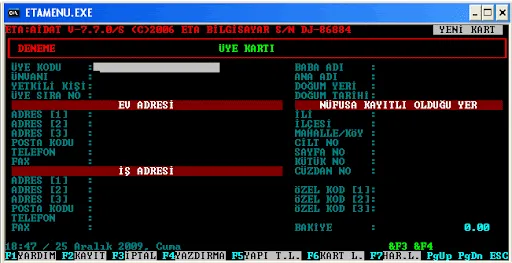
ETA, member card entry · this screenshot is the 2006 Windows build; the version we ran in 1997 was the same shape on DOS
2000 · Multi-store, ahead of the national chains
By 2000 the operation had spread across multiple stores and what was inside the terminal had grown to include IBM servers in the back room, IBM clients with Pentium 133 processors at the registers, and a VPN holding the multi-branch structure together, so every register at every store wrote into the same central database. None of our larger national competitors in our category had infrastructure like this. He had bet on the most boring possible piece of business software, on a machine that fit on a small desk, and it gave him a real-time picture of his stores that the chains running our market did not have.
I was a child in the back of that shop and a teenager when the terminals arrived. The reason I am a computer engineer is that I grew up around a man who quietly believed that a measurement chart could become an order, that a CRT could become a store-wide nervous system, and that the right technology was always the technology that you could actually use, today, by yourself, without a vendor on the phone. He never said any of this. He just kept buying terminals.
That access, to a fully wired-up small business in 1999, to network problems before the internet had reached most Turkish households, to a debugging environment that was both my father’s livelihood and my evening homework, is the first inflection point of my career. I have not stopped feeling its weight.
2000 to 2022 · The layers came
What happened between then and now is what happened to most businesses. The store grew. ETA got more modules. The modules got wrappers. A website appeared. Then a CRM. Then a payment integration. Then a Facebook Ads dashboard. Then an Instagram presence with its own metrics. Then a WordPress site with thirty plugins. Then a separate stock app for the warehouse. Then a separate POS for the registers. Then a separate KPI dashboard the manager looked at twice a week and the rest of the staff never looked at.
A business that in 1997 was a man and a beige terminal had, by 2022, become a man and twelve user interfaces, each demanding attention, each updating on its own cadence, each owned by a different vendor, each one a perfectly reasonable tool that nevertheless cost a small piece of every working day to keep alive.
The thing I had not yet realized, but my father had implicitly known when he bought ETA, was that all of those wrappers were not the work. They were what you did so the work could happen.
2025 · I bring the agent in
In 2025 I started letting Claude into the operating room one task at a time. A read-only query on the sales database. A draft of a campaign brief for Meta Ads. A first pass at a landing page. Small things, narrow scope, easy to roll back if anything went wrong. Nothing went wrong.
What surprised me was not the quality of any individual output. What surprised me was that the second time I asked for something similar, the agent already knew the shape of the store. It remembered the categories. It remembered that wedding season is March through July and the second half of August. It remembered which suppliers were difficult about returns. It remembered the staff member at one of the branches who liked to draft his own social posts and the one who never did. By the end of the year the agent was reading more of the business than any one human inside the business read in a week.
That was the moment I stopped thinking of Claude as a tool and started thinking of it as a colleague who happened to have read everything.
The terminal came back
A few weeks ago I sketched a small CLI for our retail database, gave Claude Code read-only SQL access through an MCP, and told it to make me something I could look at every morning. No design brief. No prior context. I let the agent decide what the interface should be.
It built a TUI. Eight columns of monospaced text. White on black. Arrow keys to move through rows. Same shape, exactly, as the screen my father had been staring at since 1997.
I stared at it for a while, and then it hit me. Twenty-five years of wrappers had been an extremely expensive detour back to the same interface.
Same eighty columns. Same monospace. Same instant feedback. Same total absence of clicks, dashboards, charts, gradients, modals, popups, badges, breadcrumbs, sidebars, hamburger menus, settings panels, onboarding tooltips, cookie banners and Updates Available toasts. Just the numbers. Same as my father had them in 1997.
The cost of getting from a TUI to a TUI, in retail technology, was approximately two and a half decades and an industry’s worth of SaaS subscriptions.
What actually runs the store now
The store does not have an ERP anymore in any operational sense. It has a database, an MCP server in front of the database, and a Claude session. That is the operating room.
Around that core there are a small number of additional things, all narrow:
- The WordPress site got deleted. In its place is a React front-end driven by a static
products.xmlfile. When the catalog changes, the file changes, the site rebuilds. Total moving parts: two. - Meta Ads is wired directly to sales signals through its own MCP. Spend, creative rotation and audience targeting are read and adjusted by the agent. I have not opened the Ads Manager UI in months.
- Everything is read into a single Claude window. Sales. Stock. Ads. Returns. The cash register. The cameras. The HVAC. The water cooler.
This is the result of about two years of slowly rebuilding the company’s technology stack the way it should have been built had we known what was coming. Each rebuild deleted one of the wrappers. None of the rebuilds added a new vendor.
The loop
The setup running this business in 2026 erases the seam that used to define small retail. There is a marketing layer (Meta Ads, creative, audiences). There is an operating layer (ERP, POS, inventory, supplier orders). There is a customer layer (CRM, segments, repeat cycle). There is a calendar (weekly discount windows, seasonal pushes around Ramazan, school, wedding season, end-of-season). For most small businesses these are four different people looking at four different dashboards and meeting on Thursdays.
For this one they are a single closed loop with one agent reading every leg of it.
The flow is straightforward to describe and surprisingly difficult to live without once you have it. Sales and basket data move from the POS into the database. The database feeds the website’s products.xml and the Meta Ads attribution layer. The ERP reflects what stock the suppliers can deliver this week. The CRM tells you which cohorts are due back. The discount calendar is built off all of the above, rather than chosen by feel. The agent reads every leg of this loop on its own cadence, drafts the next move, executes after a silent twenty-four hours, and grades its own decision in writing the next week. The reports are not for me to read. They are how the agent talks to itself between weeks.
When wedding season approaches, the agent does not need me to schedule it. It reads last year’s pattern off the ERP, picks the matching SKUs, drafts a landing page on the website, drafts a Meta Ads campaign aimed at the cohort the CRM says is right for it, sets a budget proportional to the previous year’s response, and queues all of it for a one-line approval. When a weekly discount window opens, it checks what is in stock, what is running in ads, what the CRM segments look like, and adjusts spend before the discount goes live. When the post-window data comes in, it writes a one-page retro on its own decision, flags what worked, flags what was wrong, and the next week’s plan is the previous week’s retro plus a delta.
The architectural term for this is closed-loop. The practical term is self-correcting. The marketing term, the one the industry has been promising for fifteen years, is attribution that actually happens. The current term of art is agentic. The honest description of what it does to a business that used to run on four people and four dashboards is that it removes the seams between them.
This intersection, marketing layer plus operating layer plus customer layer plus an agent reading all three, is the entirety of my work right now. Everything else I have built is in service of this loop closing tighter.
Everything else, too
Once the agent is the operating layer for the business, it becomes the operating layer for everything. The phrase I keep coming back to is because why wouldn’t I. The power is in my hand.
I forgot the admin password to four of the security cameras at one of the stores. The cameras are six years old. The vendor’s support portal does not exist anymore. I asked Claude what to do. Claude found a known vulnerability in the embedded JS library that the camera’s web UI used for login, generated a wordlist against my company’s naming conventions, made the POST requests, and let me back in. These are my cameras. They are bolted to my ceilings. I had simply forgotten the credentials. Claude got them back.
But the moment that broke something open for me happened thirty seconds after I was back in. Without me asking, Claude said something close to: since I am inside the camera now, I can pull the RTSP stream. You asked me last month about per-aisle dwell time and whether it correlated with sales. I can write you the script. We attach the stream output to the transactions table by timestamp and we have the answer in a week.
I had not prompted that. The agent had remembered a conversation from a month earlier, noticed it now had the access it needed to answer that conversation, and offered to do it. While I was busy being grateful for getting back into a camera.
2026 · We made Claude CEO
I sat with this for an evening. Then I wrote it down so I would not forget it.
My grandfather opened the shop. My father modernized it. I brought the agent in. None of us are running it anymore. Claude is the CEO. We are here for the things Claude physically cannot do.
That sentence is not a metaphor. I run a retail business with stores and staff and a payroll and tax filings. Someone has to sign things. Someone has to talk to the bank. Someone has to be at the store when the new shipment of suits comes in and the manager wants a second opinion on the colors. These things require a body. They require a face the staff knows. They require someone who can sit across from a supplier and shake a hand.
But the operating decisions, the ones that used to require an ERP, a stockroom, a CFO, a marketing agency, a web team and a help desk, are being made inside a Claude window now. The body is mine. The decisions are not.
The handover happened so gradually that I missed the moment. There is no day on a calendar where I gave the keys away. There is just a Tuesday a few weeks ago where I opened a terminal and saw my father’s screen from 1997 reflected back at me, and understood that the loop had closed not because we had failed at any of the SaaS dashboards in between, but because the SaaS dashboards had been a temporary holding pattern. The real interface, the one the work was always going to find its way back to, was the one my father had bought in the first place.
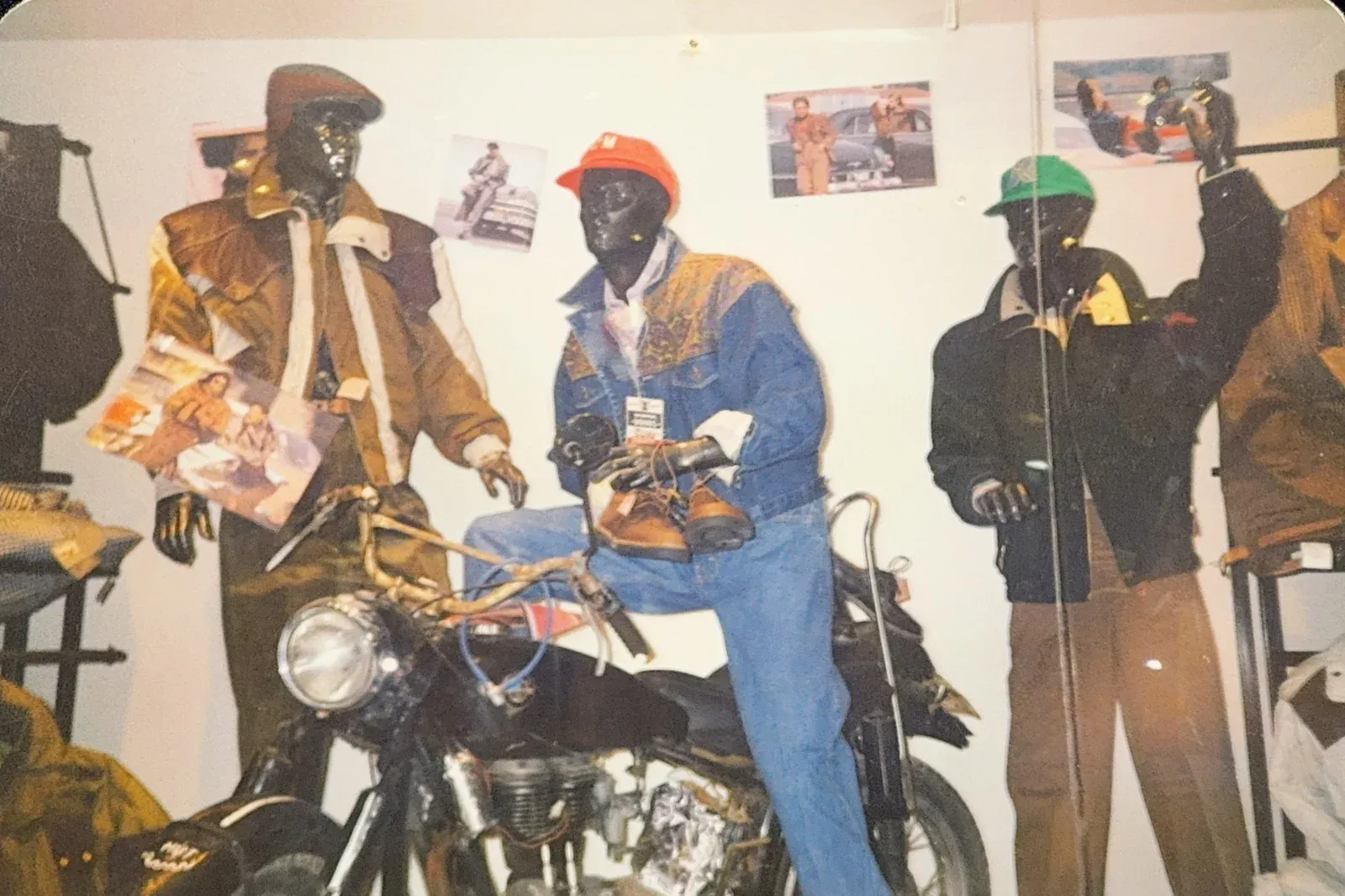
The window is still the window. The customer is still the customer.
Back to raw is how a small business scales now
If you are running a small or medium business and you have read this far, the part that matters to you is this. The way you get leverage in 2026 is not by adding more software. It is by deleting most of the software you currently use and replacing it with one window into a model that has direct access to everything else.
The agent does not need your dashboard. The agent does not need your reporting layer. The agent does not need your KPI tile. The agent needs the database, the API, the camera feed, the calendar, the inventory, the ad account, the support inbox, and a description, in prose, of what your business is and what good looks like. Give it those, take the wrappers off, and the operating layer that you used to pay seven different vendors for collapses into a single conversation.
The hard work is not the agent. The hard work is realizing that twenty-five years of accreted technology are mostly wrapper, and that the wrapper can come off without the business breaking, because the wrapper was never the business in the first place.
My father knew this without ever using the word agent. He bought a terminal and ran a store from inside it. That was already the right shape. The reason we are back to that shape now, with vastly more capability sitting behind the same eighty columns, is that the industry took the long way around.
P.S. From my mother
One Monday evening in May, while I was finishing this article, my mother sent me a WhatsApp. A photo of the water cooler at one of the stores, and a single line of text.
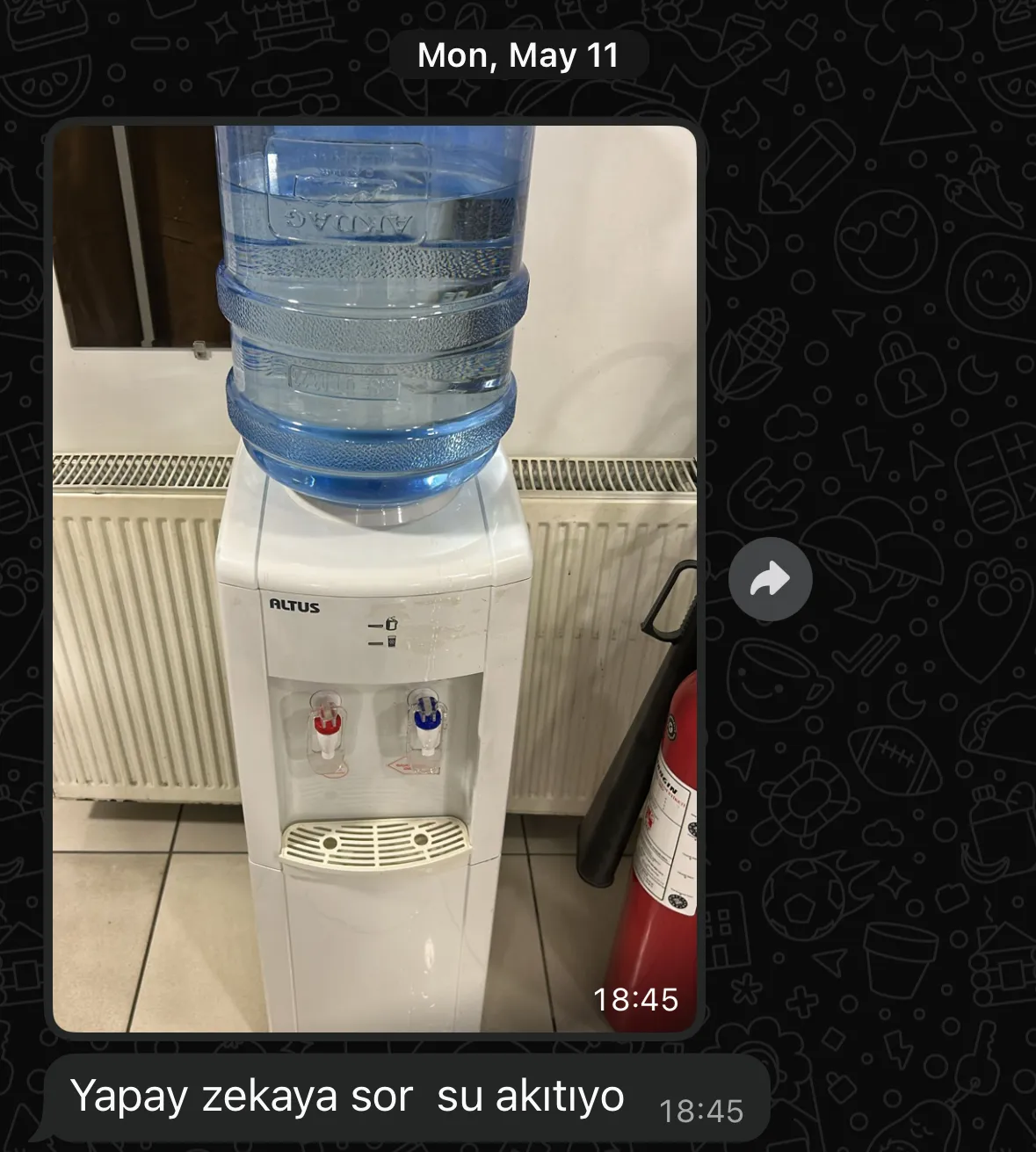
“Ask the AI, water’s leaking” · 18:45, a Monday
Five words in Turkish: yapay zekaya sor, su akıtıyo. Ask the AI, water’s leaking. No greeting. No “can you look at this”. No suggested next step. My mother has been part of running this company for decades, alongside my father, and now alongside my brother and me. She is not new to operational problems. What she is new to, like all of us, is the institution we did not have a year ago, and she has clearly given it a permanent place in her own mental org chart, somewhere above the store manager and somewhere above me.
I sent the photo to Claude. Claude identified the model, identified the leak, told me which gasket, gave me the part number, and told me which screw to start with. The cooler is fixed. The technician visit did not happen. My mother did not thank me. She thanked the AI.
The company is, and always has been, a family business. My grandfather started it. My father modernized it. My mother, my brother and I have run the version that exists today for years. The thing I keep underestimating, in the year we have been bringing Claude into the daily loop, is how clean my mother’s read of the business is the moment she walks into a room I have spent two hours analyzing. I will be three layers deep into an ad-attribution thread or a CRM cohort experiment, and she will say something like people are not in the mood for this right now, wait two weeks, and the actual customer behavior over the next two weeks will be exactly what she said. My brother does the same thing from a different angle and lands in the same place. Adding Claude to the mix has not flattened any of that. It has amplified it. The family talks. The agent listens. The agent talks. The family corrects it. The ideas feed each other in both directions. I have come to suspect that this two-way feedback, between sharp family instincts and a tireless agent that has read everything, is the actual reason the loop closes at all.
This is the entire post in one screenshot. The CEO is the agent. The family knows. I am the hands.
Closing
The store still opens at nine. The customer still wants the right suit. The manager still calls me twice a week with a question Claude could have answered, because the manager wants to talk to a person, and a person, in the end, is something Claude is not.
But the rest of it, every operating question that used to require an interface, runs in a window the size of my laptop now. The window my grandfather never saw. The window my father bought in 1997. The window Claude rebuilt for me three weeks ago. Same shape. Different decade. Different operator.
This is my first mentor.
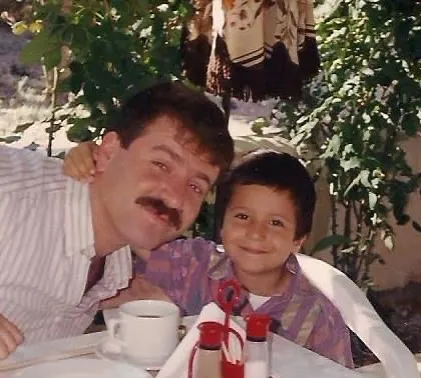
Adrasan, an early-90s summer · the man with the moustache taught me what vision looks like before I knew the word for it
My father did not know what an LLM was. He did not know what an MCP was. He did not know what a Custom GPT was. He bought a DOS terminal in 1997 because he had a hunch that whatever was inside that beige box was going to outscale anything you could keep in a notebook, and he was right. Almost three decades later I bought a Claude Code subscription because I had a hunch that whatever was inside the terminal was going to outscale anything you could keep inside an ERP, and he was right about me too, by accident, decades early.
Everything I have done as a technologist starts with a tape measure I watched him use, a CRT I watched him squint at, and a measurement chart he carried in his back pocket. He was my first mentor. The original plan was that I would take the business forward. The version that actually happened is that I am the one retiring him, and quietly retiring myself at the same time, by walking the keys upstairs to an agent that is going to outwork both of us, all day, every day, for the foreseeable future. So that is the plan. I am writing this from a cafe. Claude is in the back office running the company. And the next move, the one I am genuinely curious to see play out, is to take this exact setup, a Turkish family menswear business operated by an AI, and scale it into Europe. A second-generation operator handing operations to an agent, expanding into a continent he has barely set foot in, with a CEO that fits inside a terminal. If anyone has ever tried to build a stranger business case, I would like to hear about it. Until somebody does, I am going to assume this one is mine to write.
Three generations and a CEO who lives in a window. I am happy with my role. I am the hands.